



How the AWS Well-Architected Framework is helping US public sector organizations and enterprise brands modernize with confidence and why elite delivery mechanics matter as much as the cloud itself.
The Institutional Stakes: Trust Is Not a Technical Metric
Across the United States, federal, state, and local government agencies—alongside heavily regulated enterprise organizations—are navigating a highly complex era of digital infrastructure modernization. Transitioning mission-critical workloads to the cloud is no longer a forward-looking objective; it is a current operational mandate. However, achieving compliance and resilience demands far more than a simple “lift-and-shift” migration.
For healthcare networks managing protected health information (PHI), state agencies overseeing vital citizen registries, and enterprises running high-throughput transaction systems, the stakes of cloud deployment are absolute. A single misconfigured architecture can trigger catastrophic data exposure, violate federal compliance boundaries, and spike operational budgets without warning.
The strategic challenge for leadership is no longer about choosing to adopt the cloud. It is about establishing structural trust—building systems that satisfy strict regulatory oversight, insulate the organization from risk, and protect public and shareholder confidence.
Framing the Issue: A Diagnostic Discipline, Not a Checklist
The AWS Well-Architected Framework (WAF) is frequently described as a catalog of cloud deployment best practices. While technically accurate, that definition misses its true organizational impact. In practice, it functions as a rigorous, diagnostic discipline—an objective engineering audit designed to verify if a cloud environment is genuinely resilient, secure, and financially optimized.
The framework continuously measures infrastructure against Six Pillars of Cloud Excellence:
- Security: Safeguarding data assets, maintaining granular identity management, and enforcing defense-in-depth postures.
- Cost Optimization: Eliminating idle infrastructure, automating resource scaling, and creating total cloud financial predictability.
- Operational Excellence: Embedding declarative configuration, real-time telemetry, and automated incident responses.
- Reliability: Designing highly available, self-healing architectures that mitigate systemic downtime.
- Performance Efficiency: Maximizing compute and storage choices to match workload demands seamlessly.
- Sustainability: Reducing active compute footprints to minimize environmental and power impacts.
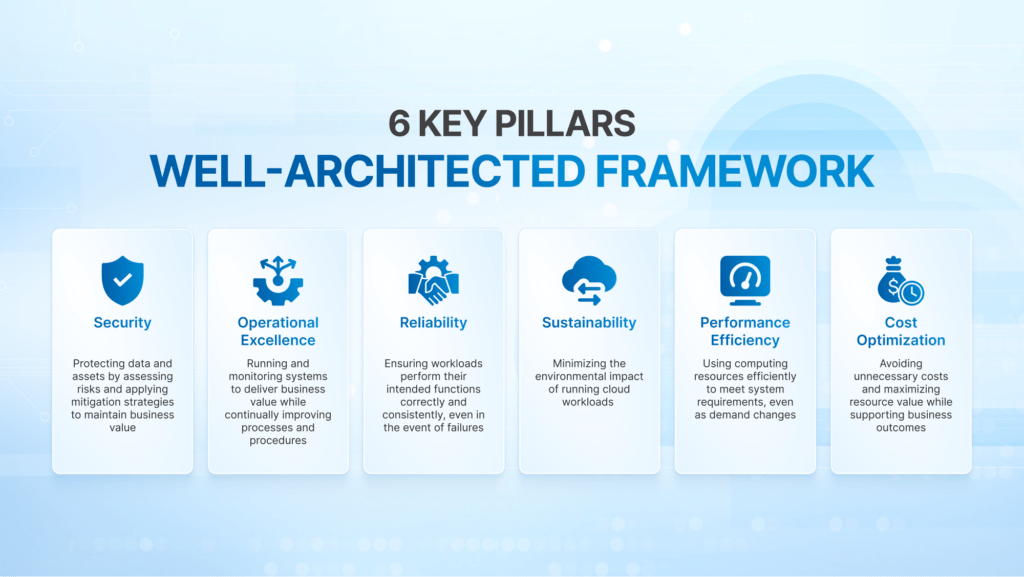
For organizations operating under intense compliance scrutiny, these six pillars are not abstract tech goals. They map directly to statutory audit criteria, service continuity metrics, and explicit executive mandates.
The Regulatory and Procurement Context: Where Mitigation Dictates Success
The US cloud landscape is defined by tight regulatory guardrails and high accountability. Organizations do not just deploy software; they navigate complex compliance structures like FedRAMP, HIPAA, CJIS, and NIST guidelines.
A state department managing public benefits operates under entirely different data privacy boundaries than a commercial healthcare system or a critical transportation authority. What these entities share is a non-negotiable requirement: they need an engineering partner who understands the legal and institutional friction of the US public and private sectors as deeply as the architecture itself.
Successful cloud transformation is not only about technology adoption — it is about building secure, scalable, resilient, and future-ready platforms that can grow with the organization and withstand the scrutiny of the institutions that depend on them.
DataHouse Cloud Practice
The Well-Architected Framework bridges the gap between raw technology and organizational governance. It translates complex architectural decisions into the exact language of risk mitigation, compliance alignment, and fiscal stewardship required by agency directors, corporate boards, and procurement committees.
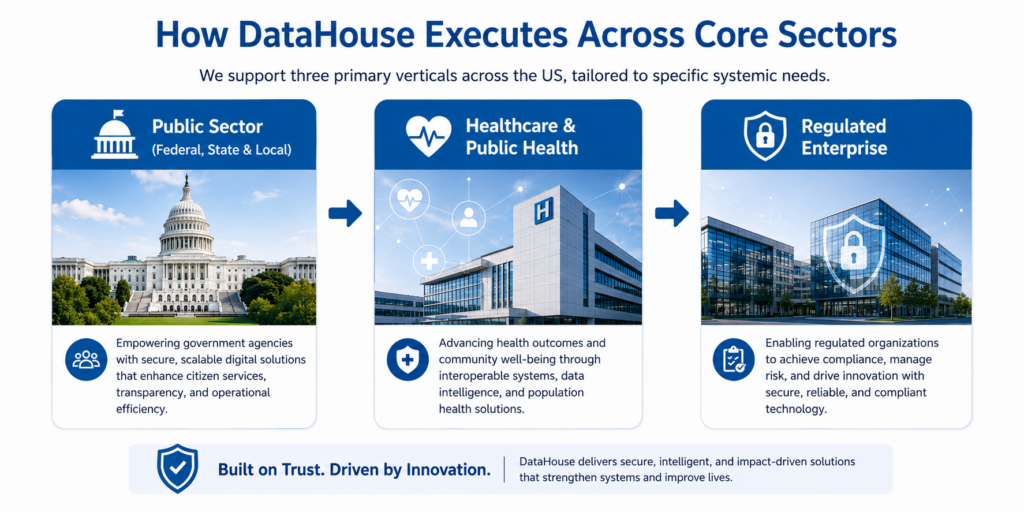
Backed by a 50-year legacy of solving complex IT challenges for public and private institutions, DataHouse eliminates the guesswork from cloud optimization. We support three primary verticals across the US, tailored to specific systemic needs:
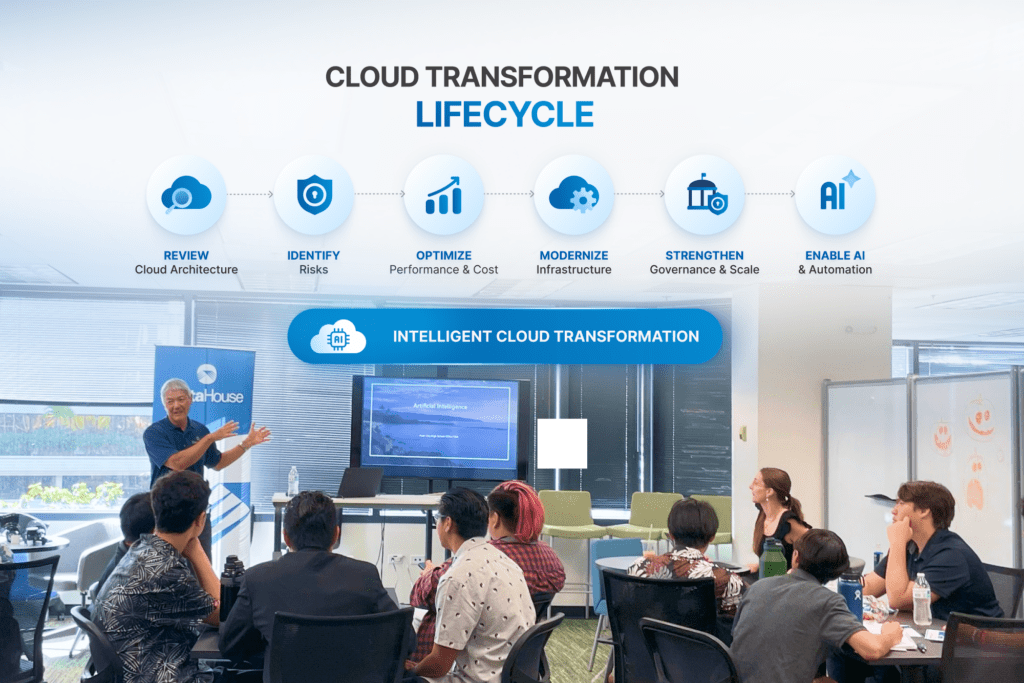
We drive measurable architecture improvement through an intentional, repeatable Six-Stage Cloud Delivery Framework:
- Architecture Review & Assessment (Review): Mapping out an unvarnished, data-driven baseline of your cloud environments against official AWS WAF standards.
- Operational & Security Risk Identification (Risk): Surfacing hidden vulnerabilities, permission bloat, and compliance gaps with actionable remediation plans.
- Workload Performance & Cost Optimisation (Optimise): Eliminating infrastructure waste and right-sizing allocations to guarantee maximum ROI on your cloud spend.
- Infrastructure Modernization (Modernise): Converting rigid legacy codebases and monoliths into agile, cloud-native, and serverless architectures without interrupting citizen-facing services.
- Governance, Reliability, & Scalability (Govern): Establishing automated landing zones and policy guardrails that empower your team to scale the cloud footprint securely.
- AI-Driven Automation (AI): Implementing intelligent machine learning workflows and automated operations to alleviate the burden on internal IT teams.
Audited Maturity Over Marketing Claims
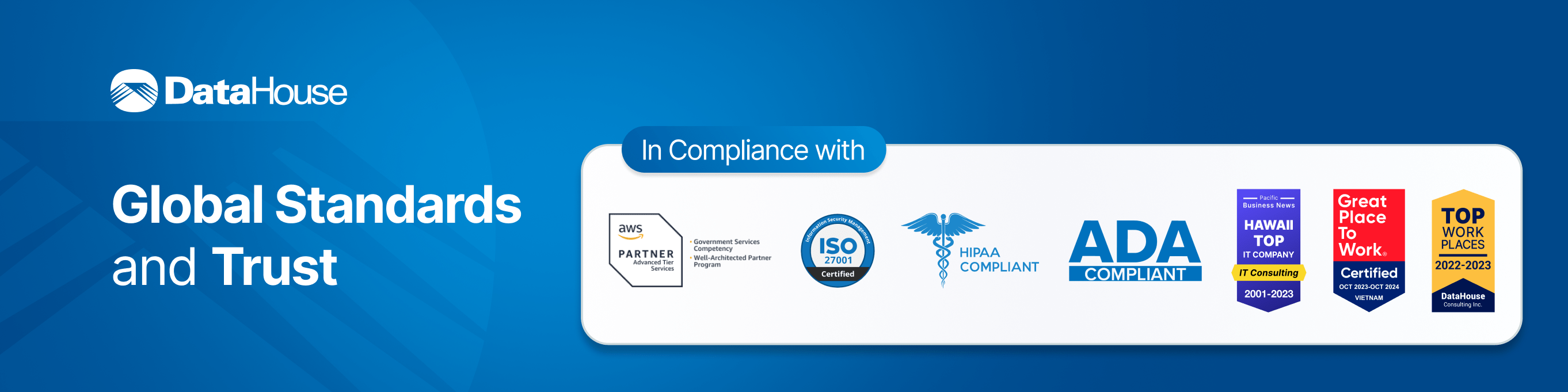
DataHouse’s official acceptance into the AWS Well-Architected Partner Program (WAPP), combined with our audited AWS Government Competency status, provides a major advantage to technical teams and procurement offices alike.
For Technical and Security Officers: It serves as independent, third-party validation that DataHouse possesses the specialized cloud architects required to resolve complex systemic defects.
For Procurement and Sourcing Teams: It significantly de-risks the vendor selection process. As an established systems integrator qualified across major public purchasing vehicles—including Federal GSA IT Schedule 70 and regional pre-qualified contracts—DataHouse provides streamlined, friction-free acquisition paths that guarantee compliance and fiscal responsibility from day one.
A Strategic Path Forward
To optimize performance, protect critical data, and ensure regulatory readiness, DataHouse recommends three immediate operational priorities:
- Priority 1: Audit existing production workloads against evolving federal and state data sovereignty guidelines.
- Priority 2: Review your current AWS billing footprint to identify and remediate architectural waste.
- Priority 3: Transition high-maintenance legacy operations toward secure, AI-assisted cloud workflows.
Partner with DataHouse Today
Do not wait for a security audit or an unexpected system outage to expose the structural weak points in your cloud infrastructure. Let our verified cloud architects help you build a foundation anchored in performance, compliance, and long-term trust.