



In the age of AI, automation, and data-driven decision-making, organizations are under increasing pressure to do more with their data.
Build real-time dashboards. Create a Customer 360. Automate reporting. Predict customer behavior. Improve operational efficiency. Introduce Generative AI into the enterprise.
It May Be Time for C-Level and Project Leaders to Check the Health of Their Data
But before investing in a new data platform or launching the next AI initiative, there is a more fundamental question every organization should ask:
Is your data actually healthy?
Data is no longer an asset owned solely by IT. It directly affects how organizations make decisions, manage risk, operate at scale, and compete. And as organizations grow, having more data does not necessarily make them more data-driven.
Without the right governance and architecture in place, small data issues can quickly become enterprise-wide challenges: duplicate records, inconsistent definitions, disconnected systems, conflicting reports, and unclear accountability when information is wrong. At that point, Data Health becomes a leadership issue, not just a technology issue.
When a Data Problem Becomes a Business Problem
Unhealthy data rarely presents itself as a single technical failure. More often, it appears through familiar questions in leadership meetings:
“Why are these two reports showing different numbers?”
“Which system should we trust?”
“Why does it take several days to produce this report?”
“Do we already have this customer in another system?”
“What data is our AI using to generate this answer?”
When these questions become routine, the issue is no longer the dashboard, database, or reporting tool. The issue is the health of the broader data ecosystem.
Data Health Challenges by Industry
Government & Public Sector: When Data Cannot Move Across Systems
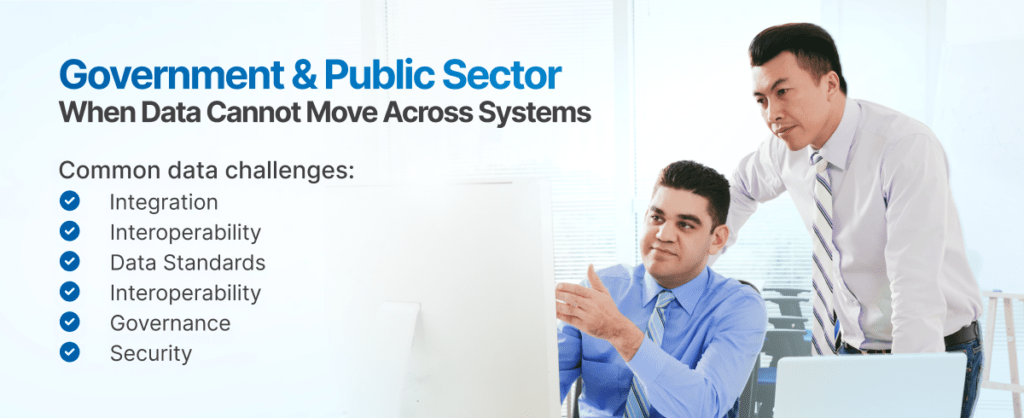
Public-sector organizations often operate systems that were implemented at different times to support different agencies, departments, and business processes. When information is isolated in data silos, the same citizen, service, case, or transaction may be represented differently across multiple systems. The impact extends beyond integration complexity.
Fragmented data can affect service delivery, processing times, reporting quality, and the ability of leadership teams to make informed decisions across programs. Common data challenges: integration, interoperability, data standards, governance, and security.
Banking & Financial Services: When Data Is Too Slow, or Too Unreliable
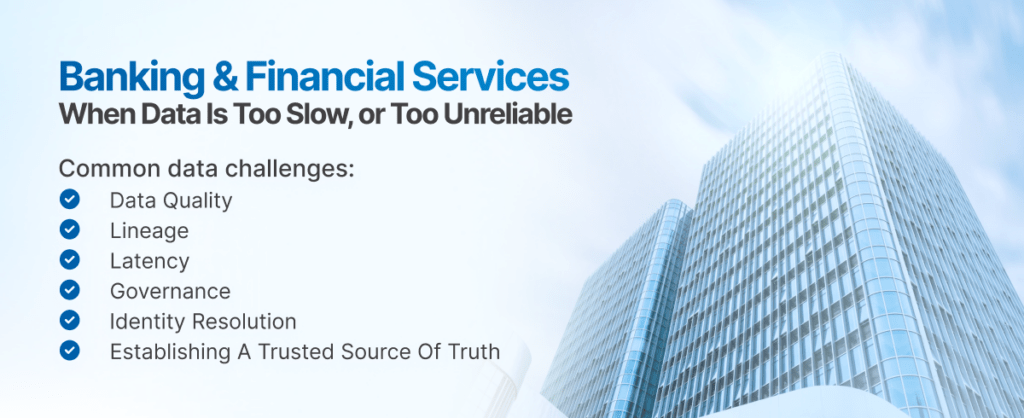
When information from core banking, CRM, lending, payment, and other operational systems is not properly integrated and governed, organizations may struggle to establish a reliable view of customers, risk, and financial performance. This becomes particularly important across areas such as:
- Risk Management
- Regulatory and Compliance Reporting
- Fraud Detection
- Customer 360
- Credit Decisioning
- Management Reporting
Advanced analytics cannot produce reliable decisions when the underlying data cannot be trusted. Common data challenges: data quality, lineage, latency, governance, identity resolution, and establishing a trusted source of truth.
Scale-Ups and Multinational Enterprises: When Growth Outpaces Data Governance
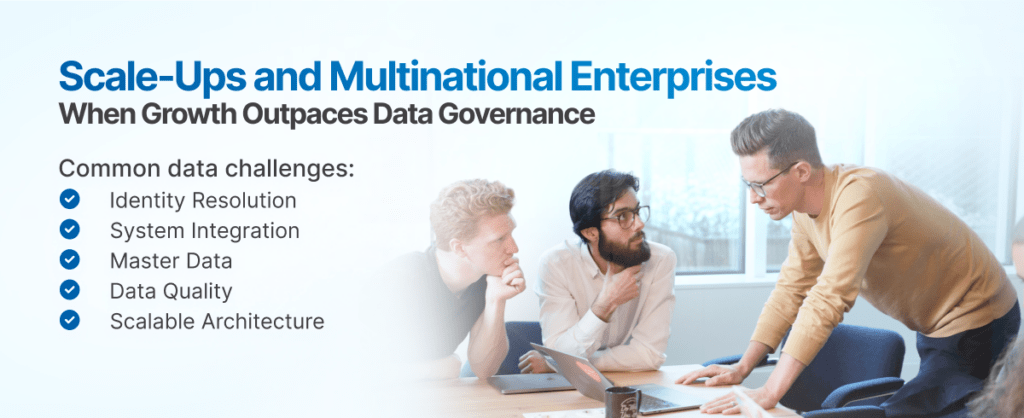
Fast-growing organizations may rely on dozens of platforms at once: CRM, ERP, advertising platforms, e-commerce systems, chatbots, social channels, logistics providers, payment gateways, and business intelligence tools.
Every system generates data. But those systems do not necessarily speak the same language. A customer may exist under multiple identifiers. An order may have different statuses across commerce and logistics platforms. Marketing attribution may not align with actual revenue.
As a result, leadership teams can have access to more dashboards than ever while still lacking something more important: A trusted version of the truth. Common data challenges: identity resolution, system integration, master data, data quality, and scalable architecture.
Five Signs Your Data May Not Be Healthy
C-Level executives and Project Leaders do not need to inspect every database to recognize a data health problem. Start with five simple questions.
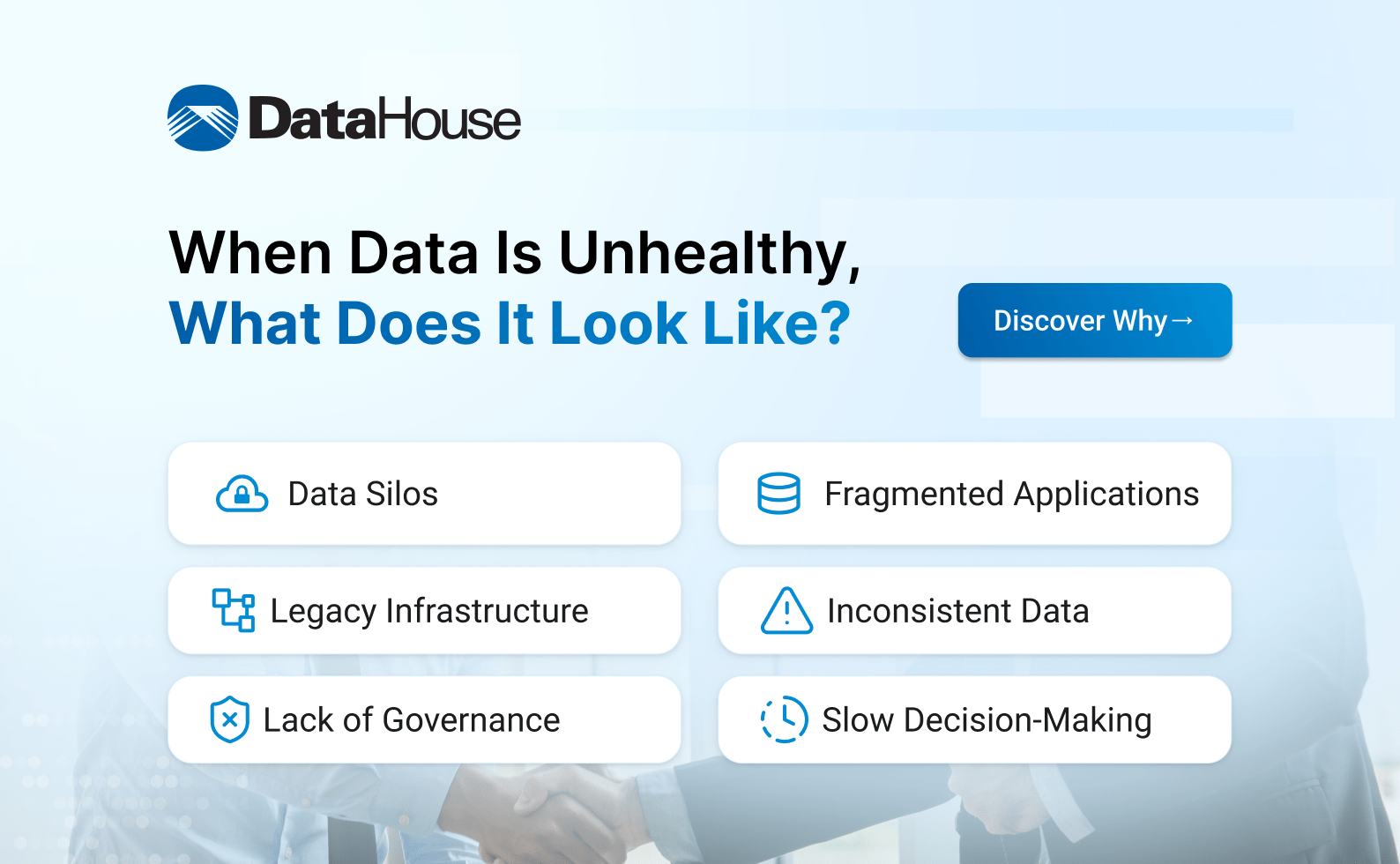
1. Can We Find It? Do we know where our critical data resides, which systems contain it, and who is using it?
2. Can We Trust It? Does the same KPI produce the same result across Finance, Operations, Sales, and executive reporting?
3. Can We Trace It? If a number appears on an executive dashboard, can we trace it back to its source and understand the transformations that occurred along the way?
4. Does Someone Own It? When customer, financial, or operational data is incorrect, is there a defined Data Owner, or does the issue simply get passed to IT?
5. Can We Use It? Can business teams use the data directly for reporting, operations, analytics, automation, and AI, or are they still spending significant time finding, reconciling, and cleaning information?
If an organization struggles to answer several of these questions, the problem may not be a lack of data. The organization may lack a healthy enough data foundation to use that information with confidence.
Data Health Is More Than Data Quality
A common misconception is that Data Health simply means “clean data.” Data Quality is critical, but it is only one part of the picture. A healthy data environment requires at least five connected capabilities:
Dimension | What Leadership Should Ask |
Data Quality | Is our critical data accurate, complete, consistent, and timely? |
Data Governance | Who owns the data? Who defines it? Who is accountable when it is wrong? |
Data Integration | Can systems exchange and synchronize information reliably? |
Data Observability & Lineage | Do we know where data originated, how it changed, and where it is being consumed? |
Data Usability | Can the business use the data for reporting, operations, analytics, and AI? |
These capabilities are interdependent.
An organization can have a modern Data Warehouse and still have untrusted data. It can implement a detailed Data Governance framework that the business does not actually use. It can deploy an advanced AI model without having a clear understanding of which source systems the model is relying on. Technology alone does not create healthy data.
AI Readiness Starts With Data Readiness
Generative AI has created a new question for almost every organization: “Where can we use AI?”
But another question should come first: “What data will our AI rely on and can we trust it?”
Consider an enterprise AI assistant with access to thousands of internal documents and multiple business systems. The model itself may be highly capable. But what happens when its source data includes outdated policies, duplicated customer records, inconsistent definitions, or information that should not be accessible to every user?
AI inherits those problems. Automation can then amplify them at scale. That is why AI readiness should not begin with model selection. It begins with:
Trusted Data → Governed Data → Connected Data → AI-Ready Data
Architecture Matters, but There Is No Universal Data Stack
Once governance and business requirements are understood, technology enables Data Health at scale.
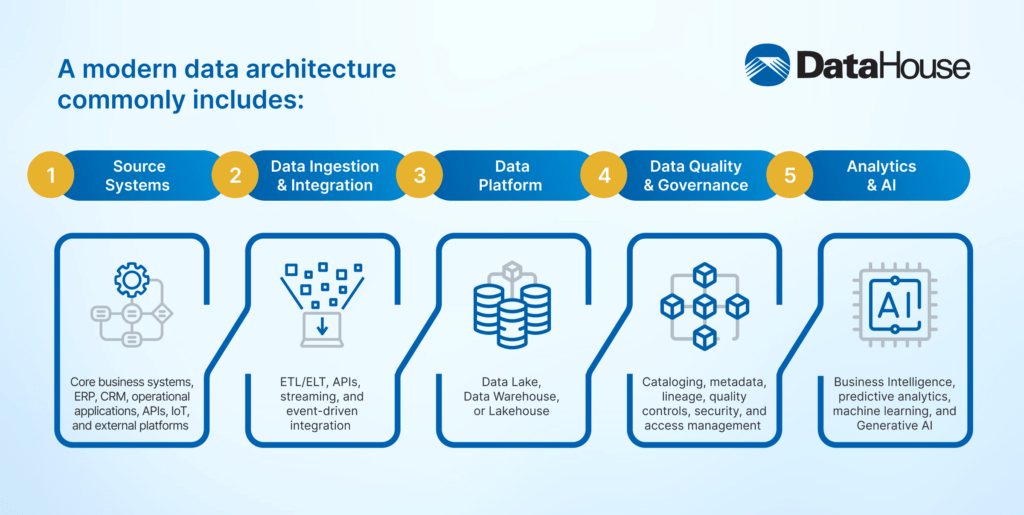
Cloud platforms and open technologies provide a wide range of tools to support these layers. Depending on the existing environment and business requirements, organizations may work with technologies such as AWS Glue, Amazon Redshift, Google BigQuery, Dataflow, dbt, Airbyte, or Great Expectations.
But the first question in a data project should not be: “Which technology should we use?”
It should be: “What business problem are we trying to solve?”
The technology stack should follow the organization’s data landscape, security requirements, regulatory environment, scalability needs, and operating model, not the other way around.
A Practical Data Health Check: Where Should Leadership Start?
Organizations do not need to begin with a multi-year enterprise data transformation program. A focused Data Health Assessment can start with one high-value business domain. For example:
- Banking Customer → Risk → Finance → Regulatory Reporting
- Healthcare Patient → Clinical → Pharmacy → Billing
- Public Sector Citizen → Services → Operations → Reporting
- Enterprise Customer → Sales → Operations → Finance
From there, organizations can follow a practical sequence.
Step 1 – Diagnose: Understand the Data Landscape
Identify: Critical Data Elements, data sources, data flows, system dependencies, quality issues, integration bottlenecks, and current ownership. The objective is not to inventory every database. The objective is to determine: where is unreliable data creating the greatest business risk?
Step 2 – Stabilize: Fix Critical Data Flows
Establish quality rules and automated controls around the information that matters most to the business. Instead of repeatedly correcting issues at the dashboard or spreadsheet level, organizations should address data problems as close to the source as possible.
Step 3 – Govern: Establish Ownership
Leadership should establish a clear relationship between: Data Owner → Data Steward → Definition → Quality Rule → Access Policy → Accountability
This is the point where Data Governance moves from being an IT initiative to becoming part of the organization’s operating model.
Step 4 – Connect: Build the Data Foundation
Once critical domains are standardized, organizations can design the integration and data architecture required to create trusted data products for analytics, automation, and AI.
Step 5 – Scale: Move From Trusted Data to Intelligence
With a healthy foundation in place, organizations can expand into higher-value use cases: Executive Analytics → Customer 360 → Predictive Analytics → Automation → Machine Learning → Generative AI
Do Not Try to Fix Everything at Once
One reason Data Governance programs fail is that they often begin with too much ambition. Organizations attempt to catalog every dataset, define hundreds of policies, and implement an enterprise platform before demonstrating meaningful business value.
A more practical approach is: start small. Start where data matters most. Prove the value. Then scale.
- Choose a domain where poor data is already creating a visible business impact.
- Establish ownership.
- Measure quality.
- Understand lineage.
- Resolve integration issues.
- Then return the data to the business as a trusted, usable data product.
When business teams begin to experience the value of better data, Data Governance stops feeling like a compliance exercise. It becomes an operational capability.
From Fragmented Data to an Intelligent Enterprise
Data maturity does not happen in a single step. Most organizations move through a progression.
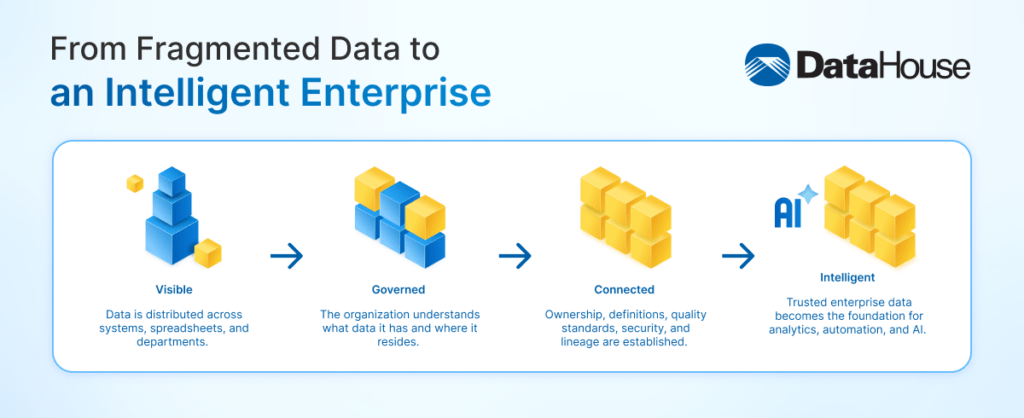
The most dangerous shortcut is attempting to move directly from: Fragmented → AI
Before Your Next AI Project, Ask One Question
AI can transform how organizations operate. Cloud platforms can help organizations process information at greater scale. Modern Data Platforms can make analytics faster and more accessible. But none of these technologies can replace a trusted data foundation.
So before asking “What can AI do for our organization?” — ask: “Is our data healthy enough for AI?”
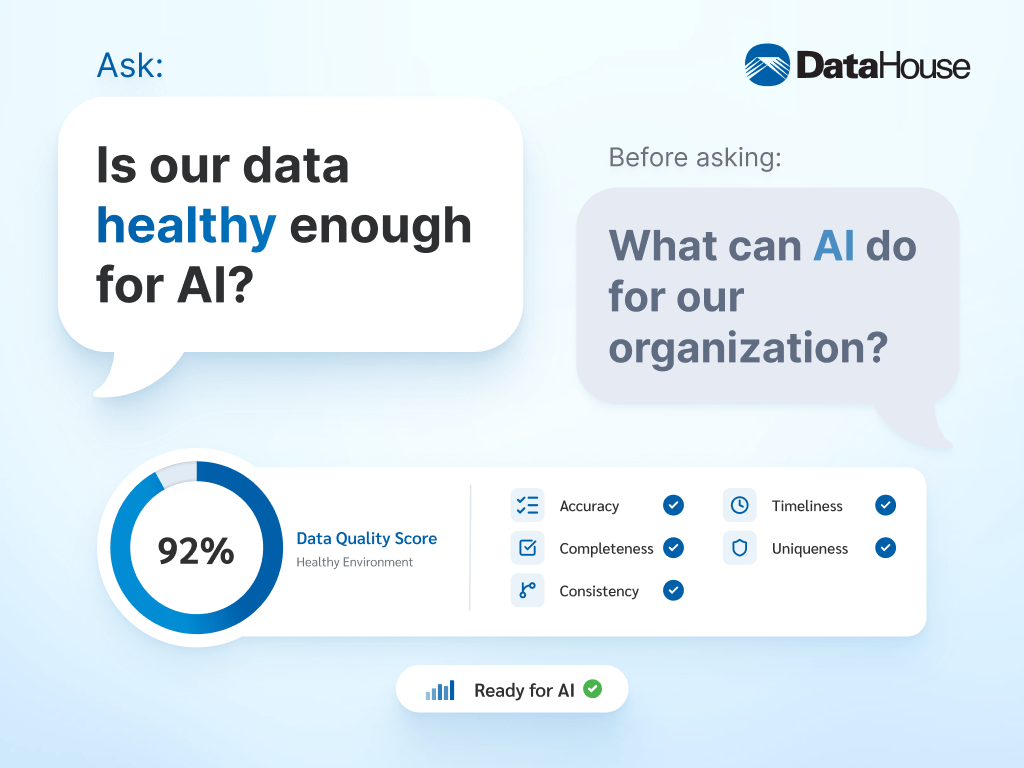
Because competitive advantage in the AI era will not necessarily belong to the organizations with the most data. It will belong to the organizations that know how to trust it, govern it, connect it, and turn it into action.
How DataHouse Can Help
DataHouse works with organizations to modernize their data environments, from understanding the current landscape to designing the architecture, integrations, governance, and platforms required for analytics and AI. Depending on an organization’s maturity and business priorities, the journey may begin with:
- Data Health Assessment Evaluate the current data landscape across quality, governance, integration, architecture, and AI readiness.
- Data Strategy & Governance Define ownership, standards, operating models, priorities, and a practical transformation roadmap.
- Data Engineering & Integration Design data pipelines, APIs, and integration architectures that connect fragmented systems and information.
- Modern Data Platforms Build or modernize Data Warehouses, Data Lakes, and cloud-based data architectures designed around business requirements.
- Analytics & AI Enablement Turn trusted enterprise data into a foundation for Business Intelligence, automation, machine learning, and Generative AI.
With experience supporting enterprise and data-intensive environments across Government & Public Sector, Financial Services, Healthcare, and Enterprise Technology, DataHouse approaches data transformation as more than a technology implementation.
We start with a simple question: What business decision should your data help you make better?
Because healthy data is not the end goal. It is the foundation for better decisions, more resilient operations, and responsible AI at scale.
Is Your Data Healthy?
It may be worth finding out before your next AI initiative begins.
👉 Ready to find out? Book a free Data Health Assessment consultation and get a clear picture of where your data stands today.