




Hospital pharmacies are responsible for much more than dispensing medications. Every day, pharmacy teams coordinate with physicians, nurses, billing departments, and patients to ensure the right medication reaches the right patient at the right time.
The Growing Complexity of Hospital Pharmacy Management
As healthcare organizations expand their services across inpatient wards, outpatient clinics, emergency departments, and specialty care units, pharmacy workflows become increasingly difficult to manage.
If your hospital is experiencing medication delays, inventory discrepancies, billing errors, or fragmented communication between departments, you’re not alone.
According to the World Health Organization (WHO), medication errors cost healthcare systems approximately $42 billion globally each year. Many of these errors stem from disconnected systems that fail to integrate prescribing, dispensing, administration, and billing processes.
This is why hospitals are increasingly investing in integrated Hospital Pharmacy Management Software to improve patient safety, operational efficiency, and revenue capture.
What Is Hospital Pharmacy Management Software?
Hospital pharmacy management software is a dedicated system that manages the full medication lifecycle within a clinical environment, covering prescription intake, drug inventory control, dispensing workflows, bedside administration, and billing in one connected process.
A Pharmacy Management System is built to work alongside other hospital systems, including the Electronic Medical Record (EMR), OPD Management System, and Revenue Cycle Management (RCM).
In a hospital, the Pharmacy Management System is one of the core components connecting clinical care with operational and financial outcomes.
Common Pharmacy Management Challenges in Hospitals
Even modern hospitals often struggle with operational inefficiencies when pharmacy workflows rely on disconnected systems. Without an integrated pharmacy Management System, hospitals face recurring failures across clinical coordination, inventory management, patient consent, and revenue capture.
Fragmented Inpatient and Outpatient Workflows
When pharmacy operates on a disconnected system, inpatient medication orders and outpatient prescriptions share the same queue with no clear separation. Pharmacists must manually identify which workflow applies to each order, increasing the risk of errors and slowing dispensing for both patient types.
Inventory Inaccuracies and Drug Shortages
Pharmacy systems that do not reserve stock at the point of prescribing create phantom availability. A drug may appear in stock but has already been committed to another patient. For specialty medications and controlled substances, this can delay treatment and create clinical risk.
Limited Visibility into Medication Costs
Patients are often unaware of medication expenses until the point of dispensing. This can lead to disputes, cancelled transactions, and additional administrative work for pharmacy staff.
Revenue Leakage and Billing Errors
Manual charge of entry between pharmacy and billing systems increases the likelihood of missed charges, delayed claims, and inaccurate revenue reporting.
Lack of End-to-End Medication Visibility
When medication orders, administration records, and billing activities exist in separate systems, hospitals struggle to maintain a complete audit trail and ensure regulatory compliance.
Why Hospitals Choose VizHIS Pharmacy Management System
Managing hospital pharmacy requires a system that connects every team involved in the medication process. Developed by DataHouse, VizHIS Pharmacy Management System delivers a connected solution spanning clinical workflows, pharmacy operations, and financial processes.

Integrated Medication Management
Medication orders placed by physicians automatically flow into the pharmacy workflow with patient information, dosage instructions, and clinical context already attached.
Priority Stock Allocation
Once a prescription is approved, the required medication quantity is automatically reserved for the patient, preventing inventory conflicts and reducing stock-related treatment delays.
Real-Time Billing Integration
Every dispensed medication generates a billing entry at the point of dispensing, with insurance coverage and patient costs separated in real time and pushed to the revenue cycle system, eliminating manual charge entry and post-encounter reconciliation.
Pre-Dispense Cost Consent
For high-value medications and controlled substances, patients can review and approve costs before dispensing, reducing disputes, and improving transparency.
Enterprise-Grade Cloud Foundation
VizHIS is built on VizPlatform, DataHouse’s cloud-native application platform hosted on AWS. The platform supports HL7 and FHIR integration capabilities, enabling connectivity across clinical and operational systems.
Core Capabilities and Benefits of the VizHIS Pharmacy Management System
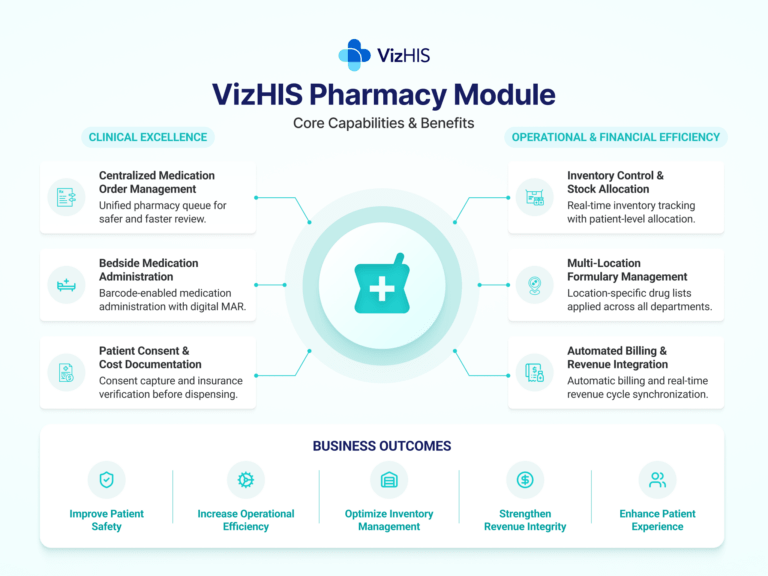
Improve Patient Safety with Integrated Medication Management
Medication orders from inpatient, outpatient, and emergency encounters are automatically routed into a centralized pharmacy workflow. Clinical decision support alerts help identify drug interactions, allergies, and contraindications before medications are approved, while barcode-assisted validation adds an extra layer of safety during dispensing and administration.
Benefits:
- Reduce medication errors.
- Improve prescribing and dispensing accuracy.
- Strengthen patient safety across the medication lifecycle
Strengthen Inventory Control with Real-Time Stock Management
VizHIS Pharmacy Management System provides real-time visibility into inventory levels across pharmacy locations, including batch and lot tracking. Once a prescription is approved, required medications are automatically allocated and reserved for the patient, preventing stock conflicts and reducing treatment delays.
Benefits:
- Eliminate phantom inventory.
- Reduce stock shortages and wastage.
- Improve inventory planning and utilization.
Increase Efficiency Through Bedside Medication Administration
The Medication Administration Order (MAO) guides nurses through bedside medication administration with order verification, timestamps, and barcode validation.
Benefits:
- Reduce manual documentation.
- Improve coordination between pharmacy and nursing teams.
- Ensure accurate medication administration records.
Improve Transparency with Patient Consent and Cost Management
Before high-value or controlled medications are dispensed, VizHIS Pharmacy Platform generates itemized cost estimates, verifies insurance eligibility, and collects digital patient consent. All documentation is stored directly within the patient’s record for future reference.
Benefits:
- Reduce billing disputes.
- Improve patient communication and transparency.
- Support compliance and audit requirements.
Maximize Revenue Capture Through Automated Billing Integration
Every dispensed medication generates a billing entry in real time, with insurance coverage and patient costs separated and pushed to the revenue cycle system without manual entry.
Benefits:
- Reduce revenue leakage.
- Improve billing accuracy.
- Accelerate reimbursement and financial reporting.
Support Safe Dispensing with Multi-Location Formulary Management
Approved medication lists are defined per location and applied at dispensing, ensuring the right medications reach the right patients across all departments.
Benefits:
- Reduce wrong-location or age-inappropriate dispensing.
- Standardize formulary controls across all departments.
- Support safe dispensing practices across multiple facilities.
How the VizHIS Pharmacy System Works Across Your Hospital
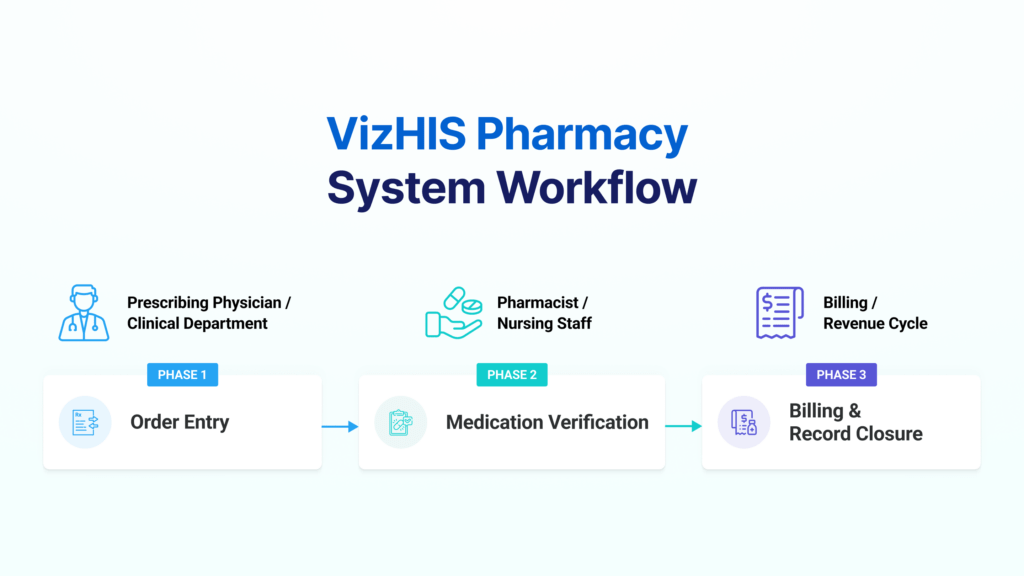
Step 1: Order Intake
Medication orders from physicians and nursing staff across clinical departments flow into the pharmacy queue with patient details and dosage instructions already attached.
Step 2: Workflow Separation and Clinical Coordination
The pharmacist reviews each order, confirms clinical details, and collects patient cost consent before dispensing. The workflow is then separated by patient type: inpatient orders are administered at the bedside via the MAO, while outpatient prescriptions are dispensed at the counter.
Step 3: Dispensing and Billing Closure
Each dispensed medication generates a billing entry automatically, with insurance and patient costs separated and pushed to the revenue cycle system.
Who Uses a Hospital Pharmacy Management System
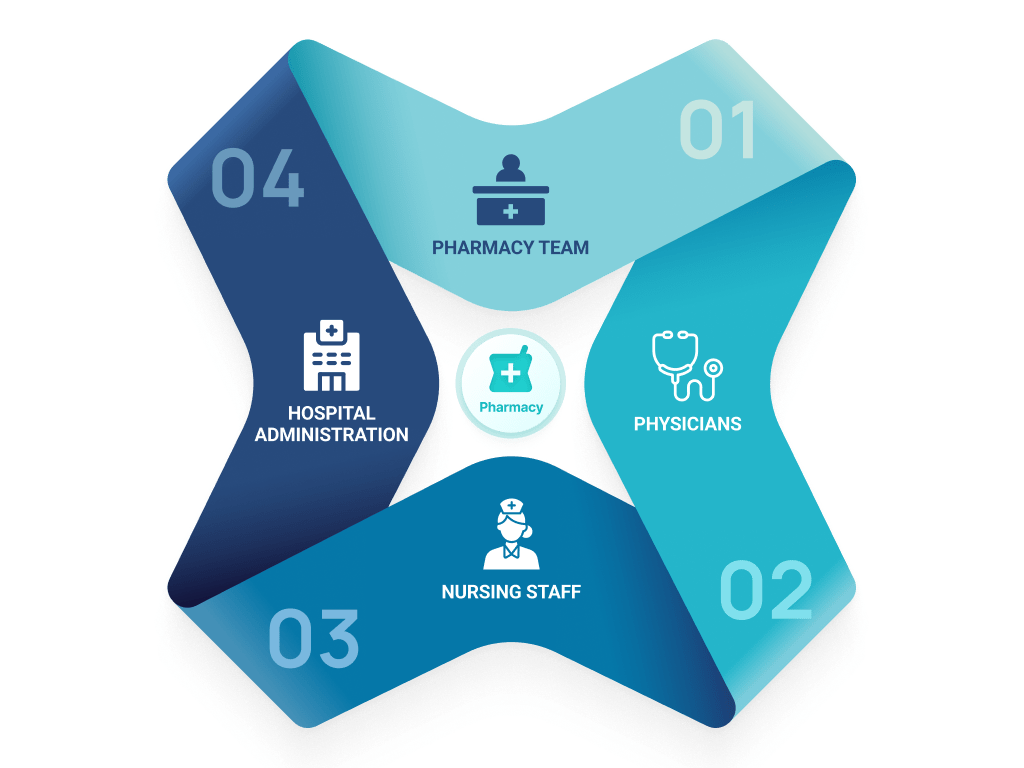
The VizHIS Pharmacy Management System supports collaboration across multiple hospital departments. The Pharmacy Team manages dispensing workflows, inventory, and formulary configuration. Physicians place and track medication orders from the clinical encounter. Nursing Staff handle bedside administration through the MAO. Hospital Administration oversees billing and compliance documentation.
Ready to Modernize Your Hospital Pharmacy Operations?
Managing pharmacy operations requires more than inventory management alone. It requires a connected platform that supports every stage of the medication lifecycle, from prescribing and dispensing to administration and billing.
The VizHIS Pharmacy Platform helps hospitals improve medication safety, streamline pharmacy workflows, strengthen inventory control, and maximize revenue capture.
Schedule a personalized demo today and discover how VizHIS can transform your hospital pharmacy operations.

Frequently Asked Questions
What is a Pharmacy Management System in a hospital information system?
A Pharmacy Management System in a hospital management system manages the full medication lifecycle, covering prescription intake, inventory management, dispensing, bedside administration, and billing. It connects directly to clinical, nursing, and financial workflows across the hospital.
What should an effective Hospital Pharmacy Management System include?
An effective hospital Pharmacy Management System should include centralized medication order management, real-time inventory tracking, bedside medication administration support, patient cost consent before dispensing, and automated billing integration.
How does VizHIS Pharmacy Management Software handle billing and insurance?
When a medication is dispensed, VizHIS Pharmacy creates a billing record automatically, calculates insurance coverage and patient costs in real time, and sends the charges to the billing system without manual entry.
Can VizHIS Pharmacy Management Software manage pharmacy operations across multiple hospital locations?
Yes. VizHIS Pharmacy supports multi-location formulary management, allowing administrators to define approved medication lists per location, ward, or department, with centralized visibility for pharmacy directors overseeing stock levels and dispensing records across all locations.